A cloudy morning in Jaipur is a good reason to change one part of your plan. If you came to Jantar Mantar to watch a sundial tell the time, keep a brighter part of your stay free. If you came to see how astronomers turned a courtyard into a set of measuring instruments, keep the visit. You can follow the shape of a dial even when its shadow has disappeared.
Cover photograph by Sanket Sawale / Pexels.
Look for an edge, even before you set off
At your hotel, look at the shadow of something simple, such as a railing on the paving. Can you pick out its edge? That gives you a sense of the light where you are. The sky may be different by the time you reach the observatory, so make a second decision at the entrance.
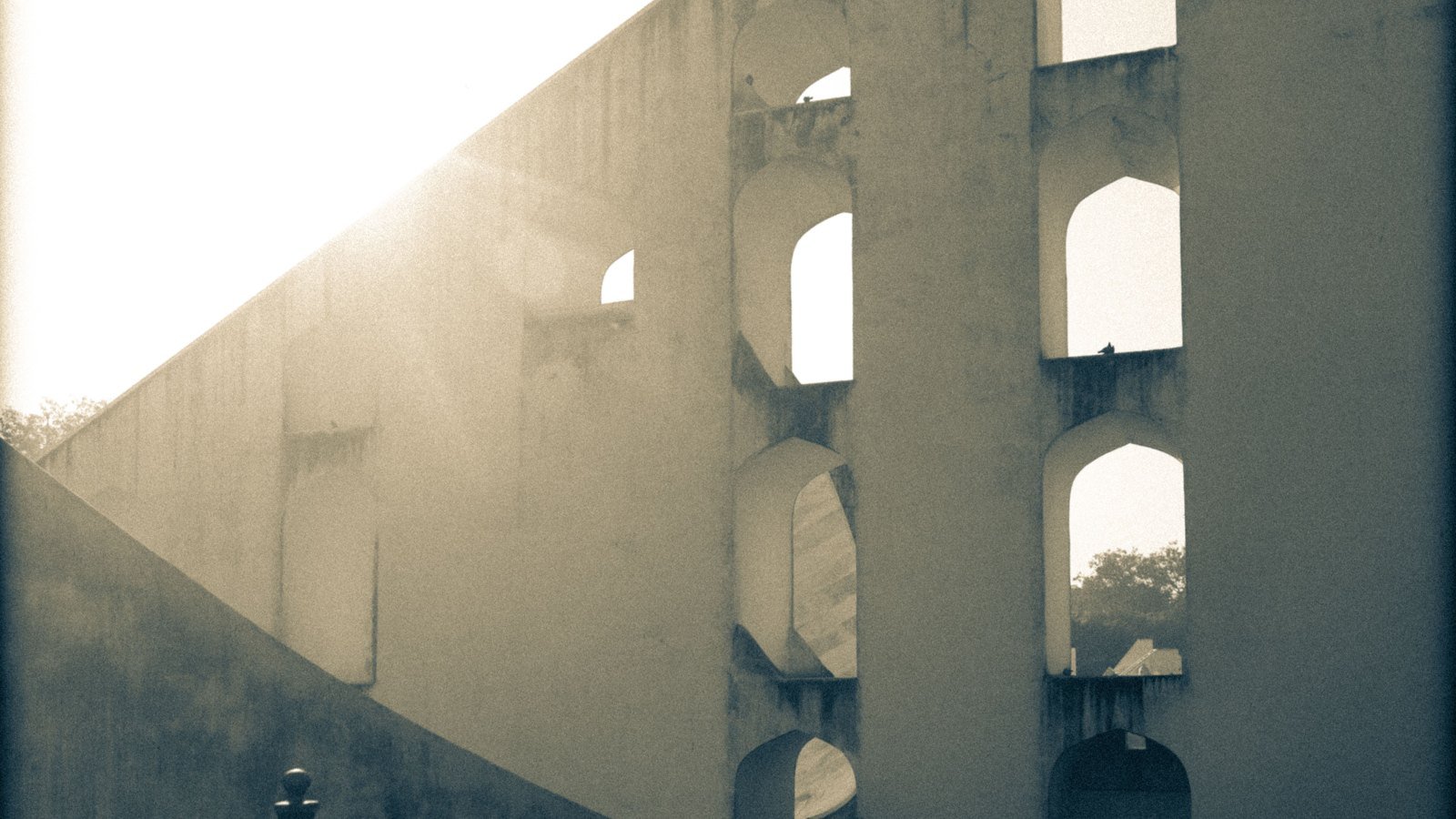
Inside, the Samrat Yantra puts the same idea to work on a remarkable scale. Find the long sloping edge and then the curved, marked scale beside it. In direct sun, the edge casts a shadow across the scale. Follow the boundary between light and shade to see where a reading would be taken. A guide can help you find the relevant marks if you would like to read them together. The dial shows local solar time, which can differ from the standard time on your phone. You can look for a reading during a sunny part of the visit without arranging the whole day around noon.
With broken cloud, watch what happens to the boundary as a cloud passes. It may soften, disappear and come back. One person can keep an eye on the scale while a companion watches the changing light on the ground. If there is still an unbroken grey sky when you intended to leave, keep the rest of your day. Stop for lunch at the time you agreed and reconsider the afternoon together.
What to look for under cloud
Look at the instruments as an observer would. From the visitor path, pick out one straight edge, one curved surface and one set of divisions. Where would you stand to see them together? Jaipur’s early eighteenth-century observatory was built for observations with the naked eye. Knowing that changes the way you look at a great sweep of masonry. Its size helped make a celestial observation something a person could read against a scale.
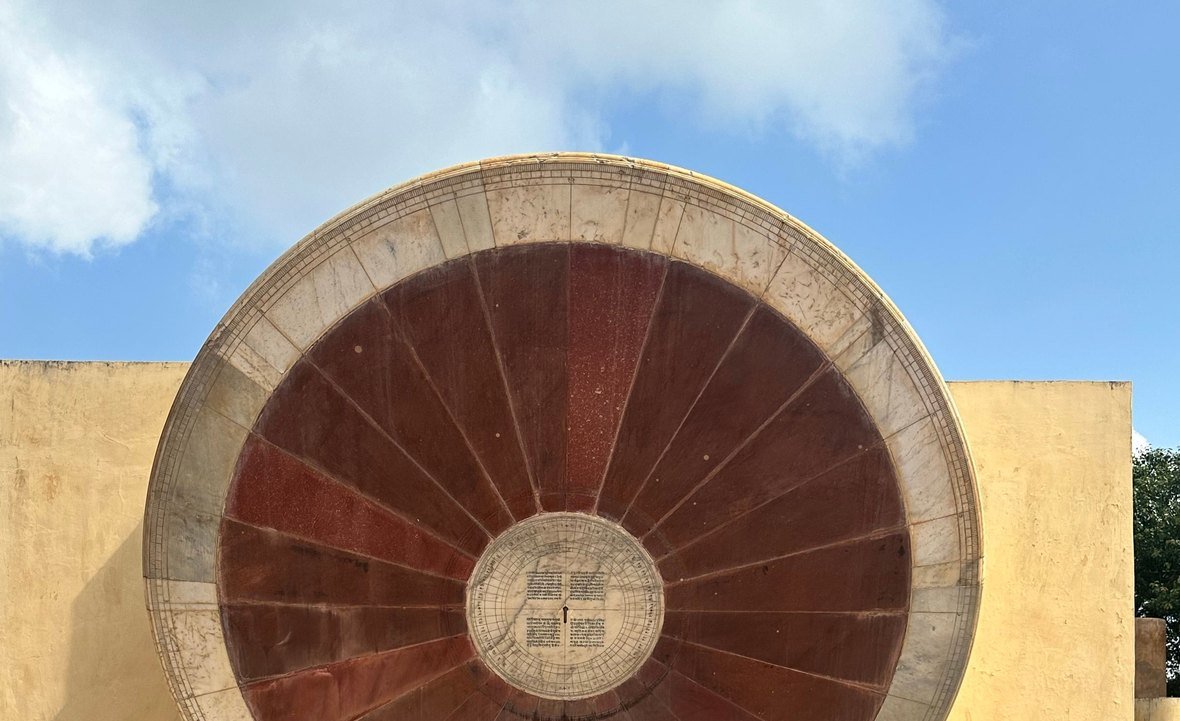
Even between patches of sunlight, the radial divisions of this instrument are visible. Detail from a photograph by Abhishek Shekhawat / Pexels.
Try the same exercise with a different shape. On the circular face in the photograph, your eye can travel from the centre along one division to the rim. Now imagine explaining its shape to someone who cannot see it. That makes a good game for a child, and a useful starting point for an adult who has never looked at an astronomical instrument. If you enjoy technical detail, ask in advance whether an interpreter is available in your language and what the visit covers. Arrange the explanation separately from your Jaipur car and driver.
Fit it around your day in Jaipur
One morning and a fixed departure. Work backwards from the time you need to leave the old city. Allow for the walk back to the agreed pickup, a meal or seated break, and the drive to your next commitment. If the sky stays grey, architecture enthusiasts can spend their available time on a couple of instruments. If seeing a working sundial is the whole point for you, spend the morning on another visit you genuinely want. Our Jaipur palace comparison can help you weigh a different half-day.
Another day in town. On a three-day Jaipur stay, look for an uncommitted daylight window that already fits your route. Check the forecast and current admission arrangements before switching days, particularly if a ticket or guide is already booked. Ask whether a change is possible and settle the revised pickup with your driver. For a wider photography plan, the regional photography guide covers other places to use good light.
Arriving today or travelling with someone who tires easily. Check in, have a break and see how much daylight remains after the drive. Ask about the distance from the drop-off, the permitted viewing route and places to sit if these affect your group. On a short visit, tracing the shape of one instrument together can be more satisfying than hurrying round the whole site.
Questions before you set off
If the reading differs from my watch, have I read the wrong mark?
Possibly, but a difference alone tells you very little. Your watch shows civil time for the time zone. The dial follows the sun at Jaipur. Ask someone interpreting the instrument to show which edge and scale to read before comparing the two.
Could we go out for lunch and come back on the same ticket?
Ask at the ticket desk before you leave. Check whether your particular ticket permits re-entry, whether a timed booking can move and when you would need to return. If a second visit would eat into your onward journey, enjoy the first one while you are there.
What if the forecast mentions a shower or a thunderstorm?
Check the India Meteorological Department’s Jaipur forecast and warnings on the day and follow local advice. If staff suspend access or issue instructions, change your plan. In particular, do not wait outdoors for a break in a thunderstorm to catch a sundial reading.
What if only one person wants to wait for sunshine?
Agree the length of the wait and a meeting place before separating. Check that anyone who wants a seat has found a suitable one, and that everyone can reach the pickup independently. If those arrangements are awkward, stay together and leave the shadow for another visit.
For the history and the instrument itself, see UNESCO’s observatory listing and Rajasthan Tourism’s description of the Samrat Yantra. If you would like help fitting the stop into your route, send us your Jaipur dates and next fixed commitment. Tell us whether seeing a shadow is the reason you want to go.